In this post, I break down dew points, humectants, emollients, and humidity so that you can confidently style your wavy and curly hair according to the weather. No more wasting time and product just to step outside and have it all fall apart.
After following the curly girl method for several years, I’ve got the basics down and learned how to work with the weather. Luckily, I live somewhere with pretty consistent temps and dew points year-round, so I don’t have to switch up my products for the seasons. I just need to make sure it’s not full-on raining, because then I definitely reach for a hard hold gel and usually leave some of the cast.
What is Humidity and Why It Matters
Ah, humidity, the nemesis of wavy and curly hair. Having lived most of my life in Miami, I’ve learned to check the weather before I even think about washing my hair.
Humidity is the amount of water vapor in the atmosphere, measured as a percentage. When it’s raining, it’s 100%. When the air is dry, it’s much lower. Most weather apps will include this percentage.
According to curl chemist Tonya McKay, “Hair exposed to very dry air without protection can lose its moisture, develop an unpleasant texture and become unruly, flyaway, and frizzy… Conversely, unprotected exposure to excessive moisture and humidity can swell the hair cortex, raising the cuticle scales and creating coarse, frizzy texture.
In high humidity (around 90%+), curls frizz and lose shape quickly. McKay also says, “This can cause curly hair to swell so much that cuticles are raised, making the surface very rough. These cuticles can tangle with others and create a huge, knotted mess that’s prone to breakage.”
So yeah, humidity usually causes chaos, but you can prep your hair to handle it.
What is Dew Point?
Humidity gets all the attention, but the dew point is actually more helpful when it comes to styling curly hair.
Dew point is the temperature at which the air becomes saturated and water vapor starts to condense. It tells us how much moisture is in the air at a given time, and that moisture can absolutely impact your curls.
Here’s why it matters:
- You can have 90% humidity in 35°F (2°C) weather and your hair might be totally fine.
- But 60% humidity in 70°F (21°C) weather can lead to big frizz.
That’s because warmer air holds more water vapor. So even at a lower humidity, if the dew point is high, your curls can swell and frizz. The higher the dew point, the more moisture your hair will absorb from the air.
Understanding Humectants and Emollients
Before we get into what to use in different weather conditions, let’s talk about ingredients, specifically humectants and emollients.
Humectants
Humectants are moisturizing ingredients that attract water from the air or your hair.
In high dew points, they pull water from the air into your hair, causing swelling, frizz, and tangles.
In low dew points, they can pull water out of your hair, leading to dryness, flyaways, and breakage.
Some common humectants:
- Glycerin
- Agave nectar
- Honey
- Sorbitol
- Hyaluronic acid
- Glucose, fructose
- Hydrolyzed proteins (collagen, keratin, silk, elastin)
- Propylene glycol
Film-Forming Humectants
These create a flexible film around your hair to help retain moisture and reduce frizz. These tend to be safer in low or high dew points.
- Flaxseed
- Okra
- Aloe vera
- Marshmallow root
- Slippery elm
- Pectin
- Guar gum
- Hydroxyethylcellulose
- Panthenol
- Hydroxypropyltrimonium honey
Emollients & Anti-Humectants
Emollients are hydrophobic (water-repelling) ingredients that help seal the hair, reduce frizz, and prevent moisture from escaping. Many plant oils fall into this category.
Anti-humectants work to block or repel excess moisture in the air. These are great for high humidity.
Some examples:
- Argan oil
- Grapeseed oil
- Jojoba oil
- Shea butter
- Mango or cocoa butter
- Olive oil
- Avocado oil
- Emulsifying wax
- PEG-8 beeswax
- C12-15 alkyl benzoate
Be aware: some can cause buildup or be too heavy for fine or low-density hair.
Emollients & Anti-Humectants
Emollients are usually hydrophobic oils that act as anti-humectants and seal the hair, like plant oils. Anti-humectants do not attract and in many cases repel water. These have traditionally been silicones, but many other ingredients function similarly to silicones.
Note that emollients can cause buildup or be too heavy for certain hair types. Check out my free Weather Styling Guide for more detailed info.
Some common emollients include:
- Argan oil
- C12-15 alkyl benzoate
- Grapeseed oil
- Mango butter
- Sunflower oil
- Cetyl esters
- Cocoa butter
- Coconut oil
- Jojoba oil
- shea butter
- avocado oil
- olive oil
- emulsifying wax
- peg 8 beeswax
Humidity Resistant Ingredients
If you live somewhere humid, you’ll want to look for products with humidity-resistant ingredients, especially in your gel or final styler. These help your hair tolerate excess moisture.
Humidity resistant ingredients include:
- Polyquaternium-4, -10, -11, -69
- Polyamide-1
- PVA/VP Copolymer
- VP/DMAPA Acrylates Copolymer
- Polyacrylate-2 Crosspolymer
You’ll usually find these in strong hold stylers. Just make sure to clarify regularly, because many do build up on the hair.
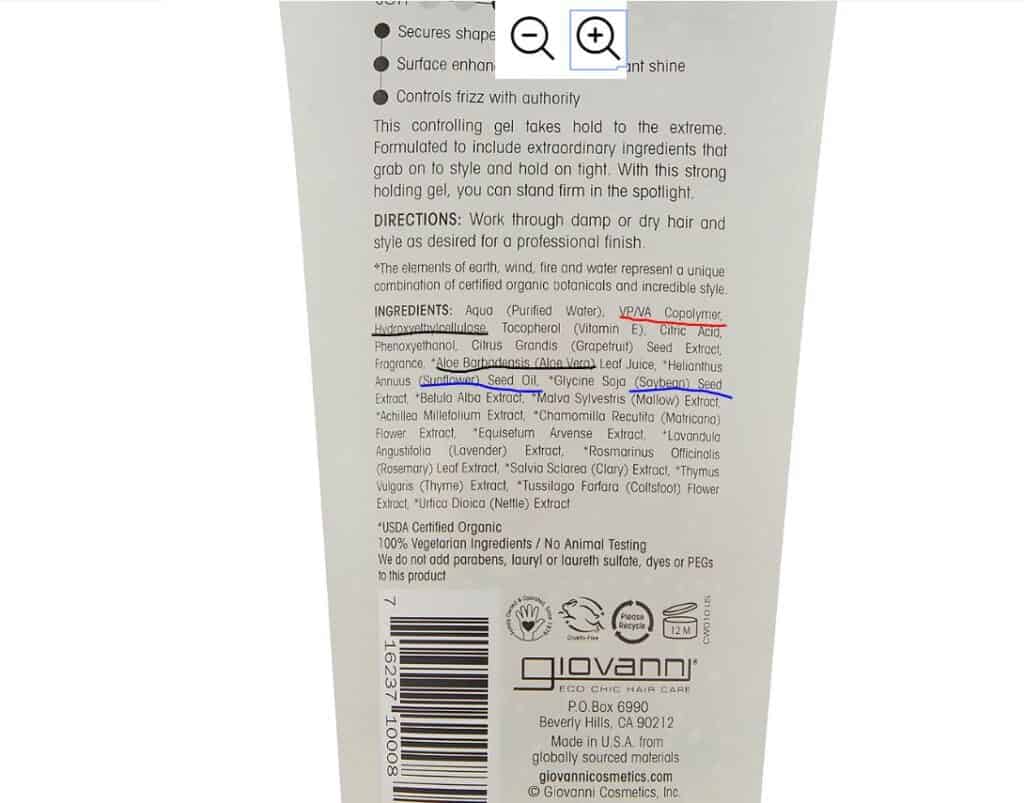
The photo below shows the ingredients list of the Giovanni LA Hold gel which is a hard hold gel that works well in high humidity and dew points. You can see the red is a humidity resistant ingredient and it’s high on the list in the second place. The black are film forming humectants, and the blue are emollients.
Dew Point Styling Recommendations
Here’s how to style your hair based on the dew point range:
Low/Dry Dew Point (Below 35°F / 1°C)
In this environment, humectants pull moisture out of your hair, causing dryness and breakage.
DO:
- Leave-in conditioner
- Light hold stylers
- Emollients and film-forming humectants
- Keep curls well hydrated
AVOID:
- Humectants (especially glycerin, honey, etc.)
High Dew Point (Above 60°F / 15°C)
Hair will absorb water from the air and swell, leading to frizz, especially for high porosity curls.
DO:
- Hard hold gel
- Anti-humectants and emollients
- Humidity-resistant ingredients
- Lightweight moisture
AVOID:
- Humectants
- Heavy moisturizing products
- Possibly leave-ins (if they weigh your hair down)
Mid Range Dew Point (30–40°F / -1–4°C)
This in-between range often requires trial and error. Some hair types tolerate humectants, others don’t.
Try both and see what works best.
Optimal Dew Point (40–60°F / 4–15°C)
This is the sweet spot! Most curls thrive here.
DO:
- Focus on balanced moisture
- Humectants
- Emollients
- Medium hold stylers
How to Track What Works
Checking dew point before wash day helps you pick the right products, but tracking what you actually use helps even more.
You can:
- Write down the dew point, temperature, and products used
- Snap a photo of your hair that day
- Use your phone, notes app, or a tracker like the Curly Journey Journal
The more patterns you can spot, the faster you’ll find what works for your hair.
Want to remember this? Save The Curly Girl’s Guide to Dew Points, Humectants, & Humidity to your favorite Pinterest board.
Trending Products

Ethique Shampoo Bars 3.88 oz

MAREE Keratin Hair Mask

Bed Head by TIGI Curls Rock Amplifier – Cur...